- Follow On:
-

-

-

-

 Blog Detail
 Stroke care is entering a new era. Advances in artificial intelligence, neuroimaging, digital health and neurovascular intervention are creating new possibilities for faster diagnosis, better treatment decisions and more personalized patient care.
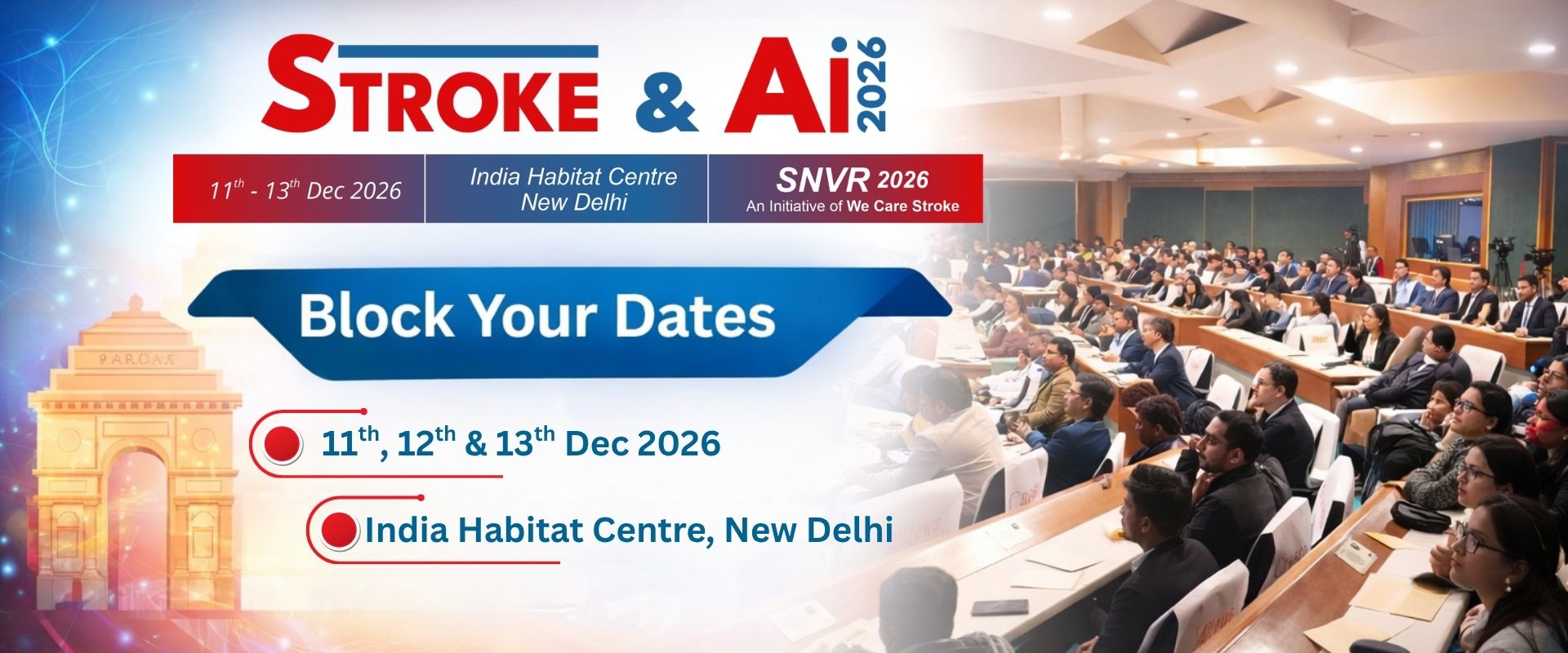
Bringing these developments together, Stroke & AI 2026 is an upcoming conference focused on the intersection of stroke medicine, neurovascular science and artificial intelligence. The conference will be held from 11th to 13th December 2026 at India Habitat Centre, New Delhi.
The event aims to bring together clinicians, neurologists, neurointerventional specialists, researchers, healthcare professionals and technology innovators to discuss how emerging technologies can contribute to the future of stroke prevention, diagnosis, treatment and rehabilitation.
Stroke & AI 2026 is a dedicated conference exploring the growing role of artificial intelligence and technology in stroke and neurovascular care.
Stroke is a time-sensitive medical emergency in which early recognition, rapid assessment and appropriate treatment can have a major impact on outcomes. At the same time, healthcare systems are generating increasingly large amounts of clinical and imaging data. AI has the potential to help healthcare professionals interpret this information more efficiently and support clinical decision-making.
The conference provides a platform to discuss these developments from both scientific and practical perspectives.
Rather than looking at AI simply as a technology, Stroke & AI 2026 focuses on how innovation can be responsibly integrated into real-world stroke care.
Dates: 11th, 12th & 13th December 2026
Venue: India Habitat Centre, New Delhi, India
India Habitat Centre is one of New Delhi’s prominent venues for conferences, seminars and professional gatherings, making it a suitable setting for an event bringing together experts from medicine, research and technology.
Every minute matters in acute stroke care. Healthcare professionals often need to evaluate symptoms, clinical history, brain imaging and other information within a limited timeframe.
Artificial intelligence is increasingly being explored across different areas of stroke management, including:
AI should not be viewed as a replacement for clinical expertise. Instead, appropriately validated technologies can potentially assist healthcare professionals by identifying patterns, processing information and supporting faster decision-making.
This balance between technological capability and clinical judgment is an important part of the conversation around the future of AI in medicine.
The conference is expected to explore a broad range of topics connecting stroke medicine with emerging technologies.
Rapid diagnosis is essential in stroke management. AI-based systems are being investigated for their ability to analyze medical images and identify patterns associated with ischemic and hemorrhagic stroke.
The conference will provide an opportunity to discuss how AI-assisted imaging and clinical tools may contribute to faster and more efficient stroke workflows.
Neuroimaging plays a central role in evaluating patients with suspected stroke.
Advanced algorithms can assist in analyzing CT, CTA, MRI and other imaging datasets. Discussions around AI in neuroimaging are particularly important because accurate imaging interpretation can influence treatment pathways and patient selection.
Modern stroke treatment can involve thrombolysis, mechanical thrombectomy and other time-sensitive interventions.
AI-based tools may help streamline emergency workflows by assisting with image interpretation, identifying potential treatment candidates and communicating relevant findings across stroke-care teams.
The key question is not simply whether AI can perform a task, but whether it can meaningfully improve patient care when integrated into a clinical workflow.
Neurovascular intervention continues to evolve with advances in devices, imaging and procedural techniques.
Stroke & AI 2026 provides a platform for discussing how digital technologies and AI could complement interventional neuroradiology and improve the efficiency of neurovascular care.
The future of stroke care is not limited to treating stroke after it occurs.
AI may also contribute to identifying risk patterns, analyzing large datasets and supporting preventive strategies. Predictive analytics and personalized risk assessment are areas of growing interest in cardiovascular and cerebrovascular medicine.
Access to specialist stroke care can be challenging in regions where comprehensive stroke centres are not readily available.
Telemedicine and digital health technologies can help connect patients and healthcare professionals with stroke specialists. Combining tele-stroke systems with AI-assisted tools could create new possibilities for remote assessment and faster decision-making.
This is particularly relevant for improving access to stroke expertise beyond major urban centres.
Recovery does not end after acute stroke treatment.
Rehabilitation plays an important role in helping stroke survivors regain mobility, communication and independence. AI, digital monitoring, robotics and intelligent rehabilitation systems are being explored to create more personalized and data-driven rehabilitation approaches.
The future may involve technology that continuously evaluates progress and helps clinicians tailor rehabilitation strategies to individual patients.
Stroke & AI 2026 offers an opportunity to understand where stroke medicine and artificial intelligence are heading.
The conference brings together professionals working across neurology, neurovascular medicine, interventional neuroradiology, research and healthcare technology.
Participants can learn about developments in AI, neuroimaging, digital health and other technologies relevant to stroke care.
Conferences provide an opportunity to exchange ideas and build professional connections with clinicians, researchers, healthcare professionals and innovators.
AI is developing rapidly, but successful implementation requires more than technology. Clinical validation, patient safety, ethics, data quality and integration into healthcare systems are equally important.
Stroke & AI 2026 provides a forum to discuss these opportunities and challenges.
As AI becomes more involved in healthcare, questions around safety, transparency, data privacy and clinical responsibility become increasingly important.
A high-performing algorithm is not automatically a clinically useful tool. Healthcare AI needs appropriate validation and must work within real-world clinical environments.
Issues such as algorithmic bias, data quality, explainability, patient privacy and human oversight need to remain part of the discussion.
For stroke care, where treatment decisions can be highly time-sensitive, technology must complement—not compromise—clinical judgment.
The future of stroke management is likely to involve greater collaboration between clinicians, researchers, engineers, data scientists and healthcare organizations.
AI can process large amounts of information, while clinicians bring medical expertise, experience and an understanding of individual patient needs. Combining these strengths may help create more efficient and personalized approaches to stroke care.
Stroke & AI 2026 provides an opportunity for this multidisciplinary community to come together and explore what comes next.
The conference may be particularly relevant for:
Anyone interested in the future of stroke, neurovascular medicine and artificial intelligence can benefit from following the conference and its developments.
New Delhi provides an ideal setting for a conference focused on the future of healthcare innovation. Bringing together India’s growing medical and technology communities, the event can help encourage collaboration and knowledge exchange across specialties.
The conference will take place at India Habitat Centre, New Delhi, from 11th to 13th December 2026.
The next generation of stroke care will be shaped by a combination of medical expertise, scientific research and technological innovation.
Stroke & AI 2026 aims to be a platform where these disciplines come together to discuss practical challenges, emerging research and the opportunities created by artificial intelligence in stroke and neurovascular medicine.
Whether you are a clinician interested in the latest developments, a researcher exploring AI applications, a healthcare professional working in stroke care or someone involved in medical technology, the conference offers an opportunity to be part of an important conversation about the future of brain health.
Mark your calendar for 11th–13th December 2026 and join Stroke & AI 2026 at India Habitat Centre, New Delhi.
For conference information, registration and updates, visit the official Stroke & AI 2026 website:
https://strokeneurovascular.com/
Stroke & AI 2026 will be held from 11th to 13th December 2026.
The conference will take place at India Habitat Centre, New Delhi, India.
Stroke & AI 2026 focuses on stroke medicine, neurovascular science and the application of artificial intelligence and emerging technologies in stroke care.
The conference is relevant to neurologists, neurointerventional specialists, radiologists, neurosurgeons, researchers, healthcare professionals, technology professionals, trainees and others interested in stroke and AI.
AI is being explored for applications such as medical imaging analysis, stroke detection, clinical decision support, prediction, rehabilitation and digital health. Its potential role is to support healthcare professionals and improve clinical workflows.
For registration details and the latest conference updates, visit strokeneurovascular.com.
Official Conference Website: https://strokeneurovascular.com/
Conference: Stroke & AI 2026
Dates: 11–13 December 2026
Venue: India Habitat Centre, New Delhi